As I’m writing more, I’m increasingly wondering about the voice of my writing. What are “writing patterns”? How can they improve my writing? How can I find my own way of expressing things?
Now
Half-formed things. Stuff I read, things that turned up on the drive home, fragments that are not notes yet. Most of them will never grow into one.
Tuesday, September 1
Saturday, August 29
“I’ve read the first paragraph of your note, and I still don’t know what Obsidian is.” One of my close friends told me this after reading the note on my website. “After attending these many interviews, one thing that I learned for sure is that, people don’t have a lot of attention these days. So you gotta keep them engaged in the first few lines.”
I re-read the passage, and found the problem. It was a problem of target audience. In my mind, I’m writing for a general reader. I didn’t want to lock my writing into a specific audience, and wanted to cater to the wider general population. But my bias made me default to a voice that’s native to my own demographic: handy with tech, productivity enthusiast, product builder, and knowledge worker.
This is a great learning about writing, and it would allow me to be more mindful of how different kinds of audiences will perceive my writings.
Saturday, August 8
The Grammar of Silence
I attended Thiru R. Seshasayee’s book launch at the Tagore Film Centre, NFDC.
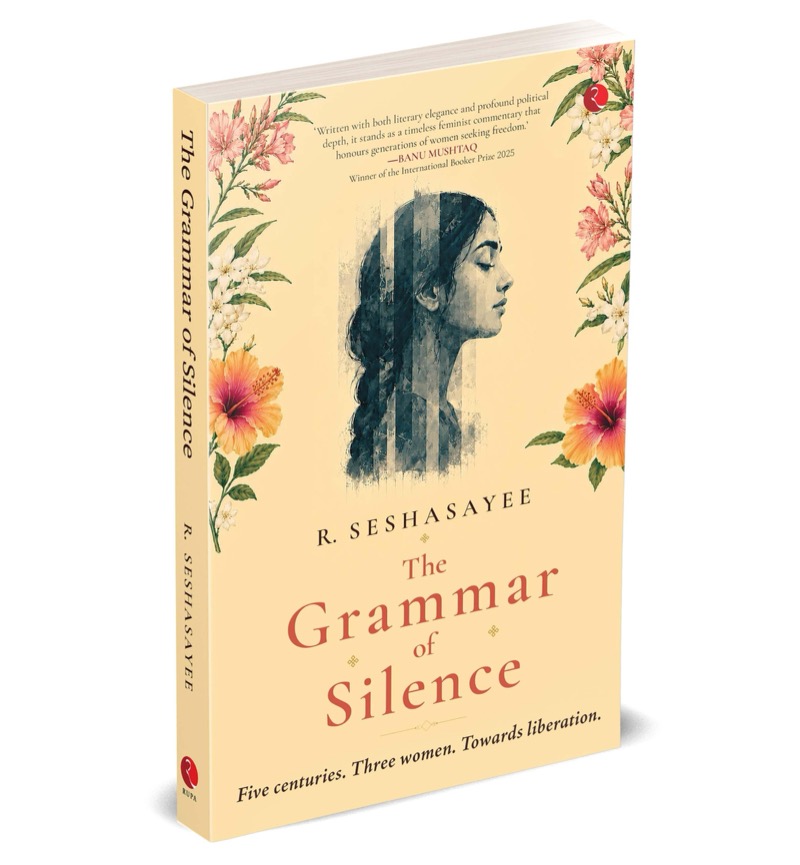
The room was presumably filled with industry titans I didn’t recognise. I came straight there after a very long day at work (we’re approaching a launch and the teams have been on overdrive for a while now), and I had no idea what to expect from an evening like this.
The book is about patriarchy and feminism. Three women, living across five centuries of Tamil history, each facing patriarchy at a different level and with different nuance.
A few things I picked up there:
- Educated and graduated are completely different things. A well educated person may not be a graduate. A person with impressive qualifications may not be well educated.
- Power leads to absolute power, and then to abuse of power. He came back to this several times, with real conviction behind it. I want to sit with that one.
- Someone asked how an industry titan could also be a creative writer (put more politely than that, but that was the gist). He said a person can hold multiple identities, and that it’s a stereotype to assume a captain of industry has no room for other forms of art. The identities part stuck with me. I have a forming theory about individual and group identities. Who am I as a person is the individual one. Who am I as a friend, a Zoho-ite, a Tamilian, an Indian, a Hindu, a millennial: those are group identities. What I realised today is that the individual self also splits. Who am I as a writer? As a product manager? As a DnD player? As a teammate? Maybe I’m blurring the two categories. Needs more brewing.
- Another person asked whether, in all his research on how patriarchy shaped our culture, he found evidence that it ever served a real purpose. His answer: it did, back when gender roles weren’t a rule but a survival arrangement. A pregnant homo sapiens couldn’t hunt, or defend herself and everyone around her, when things turned dangerous. It served a purpose there.
I left motivated enough to buy a signed copy, and more energised than when I walked in.
Thursday, August 6
Good design follows human intuition
I use Wispr Flow to dictate into my Mac. This has been my preferred way to interact with my AI agents. Wispr Flow has a neat shortcut to trigger the voice dictation: I just hold the Fn key while dictating and leave it when I’m done.
Previously, I’d lean toward my MacBook mic and whisper so I didn’t disturb anyone, or grab my AirPods just for this. But the problem with an AirPod is that there is a slight delay between triggering the shortcut and Wispr Flow picking up my voice to transcribe. So I bought a wired JBL earphone with a mic, which gave me no lag between the key press and the dictation, just like using the in-built mic.
As I started using it, I noticed my hand going to the button next to that mic whenever I wanted to dictate.
Wispr Flow doesn’t let you bind a media button hold to dictation, though. So this wasn’t an instructed product workflow.
It is a perfect case of good design following human intuition. Wired mics are often recommended for Wispr Flow in a work environment. Let’s say they had actually built this! It would’ve been easy for us to look at that good design and say “isn’t that obvious?”
Someone outside the product industry wouldn’t often catch this as a pain point and file a feature request saying their thumb keeps landing on the wrong button. It can only be identified when the builders are keen on living the user’s life.